A curriculum
in four
movements.
This journey is not an accumulation of techniques. It is a gradual path — from the first quality of presence in touch, to the experience of energy expanding beyond the boundaries of the self.
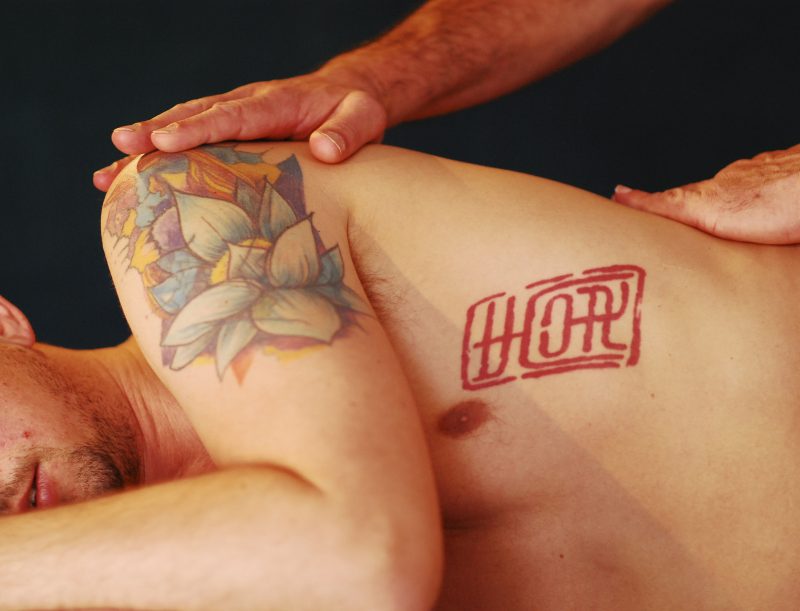
Awakening.
Discovering what it truly means to touch.The body is not an obstacle on the path to consciousness. It is consciousness itself — its very ground. This first weekend begins from this foundational conviction of tantric traditions: touch, when practised with presence, breath and non-intention, becomes a genuine path of inner transformation.
Before any practice, a framework is established with care — explicit and renewable consent, non-judgement, individual responsibility — not as a social rule, but as the very condition of authentic encounter. Consent is approached in its deepest dimension: the inner capacity for discernment that allows one to recognise what is right for oneself before the mind intervenes.
The practice of conscious caress, inspired by the Vijñāna Bhairava Tantra, then invites each participant to inhabit the point of contact with such refined attention that the boundary between the one who touches and the one who receives begins to dissolve. What is sought here is not technique. It is a quality of presence that recognises in the entire body — including its habitually excluded zones — a space of the sacred.
Consent as inner discernment
Conscious caress · Sacred body meditation
Non-duality · Presence · Responsibility
Deconstruction.
Finding the body behind its representations.One cannot truly meet another body without first beginning to recognise one’s own. This second movement explores that path: leaving behind the representation of oneself to return to the living experience of the body. The social, familial and cultural conditionings that have shaped us are named and looked at directly — not to reject them, but to stop confusing them with what we are.
Tantra is a school of deconstruction. Traumas are part of us — but they do not define us. Who are we, truly, beneath the layers of inherited injunctions and patterns? Dance, sound, movement, circles of speech, and a gradual introduction to conscious massage each offer a different angle of approach to this question.
The extreme slowness of the gesture is demonstrated here not as a technique, but as a philosophy: it is not about massaging a body, but about entering into relationship with a whole person carrying a singular history. The awareness of this responsibility — an absolute humility before the unknown that the other always constitutes — runs through every practice of this movement.
The masseur's responsibility
Dance · Sound · Conscious massage introduction
Humility · Slowness · Deconstruction
Encounter.
Approaching the territory of the other.This third movement approaches a particular territory of the body: the genital region. Not because it is more important than any other, but precisely because it is often the one on which the most representations, taboos, projections, fears and expectations have accumulated. The thread running through this movement is not the learning of a technique — it is a philosophical question: what have we deposited on this territory, and can we see the signs clearly enough to find, behind them, the body itself?
The first day is a path toward oneself: reactivation, meditation, the practice of the gaze, traversal. The second gradually leads toward the other — but an other whom one does not claim to know in advance, whose reactions one cannot interpret, and whom one approaches through a consent understood not as a permission given once, but as a permanent and living dialogue.
Giving and receiving are not two opposing experiences. They reveal two aspects of the same capacity: the ability to be truly present. The movement closes in an integration circle, with one simple recognition: what was being sought was not elsewhere. It was already here, in the body, in the breath, in the consciousness that perceives.
Consent as living dialogue
Sacred body · Yoni & Lingam · Conscious massage
Presence · Listening · Integration
Expansion.
Letting the breath become larger than oneself.This fourth movement is not a conclusion. It is an opening. The three preceding movements have progressively set aside the layers — representations, fears, conditionings — that separated each person from their own body and from the other. This weekend is the space of what becomes possible when those layers have lightened.
Circulating energy — breath, sound, movement — is no longer simply a pedagogical tool: it becomes a lived experience, in which the boundary between giving and receiving, between self and other, between the individual body and something vaster, begins to dissolve. What tantra calls expansion is not an exceptional state reserved for a few. It is what emerges naturally when presence is stable enough for energy to circulate without being captured, directed or retained.
Integration here is not a mental process of ordering or understanding. It is the silence that follows the storm — the landscape that appears when the signs have fallen. The practices of this weekend — breath, sound, collective movement, periods of deep silence — are not aimed at producing a particular state. They create the conditions for something to emerge that was already there, waiting to be recognised.
What was being sought was not elsewhere. It was there, in the body, in the breath, in the consciousness that perceives — and that, finally, allows itself to be traversed.
Integration of the three movements
Breath · Sound · Collective energy · Silence
Expansion · Dissolution · Presence
Join the journey.
Each movement can be attended independently. To be informed of upcoming dates or to register your interest, write to us.
Get in touch